 EN
EN

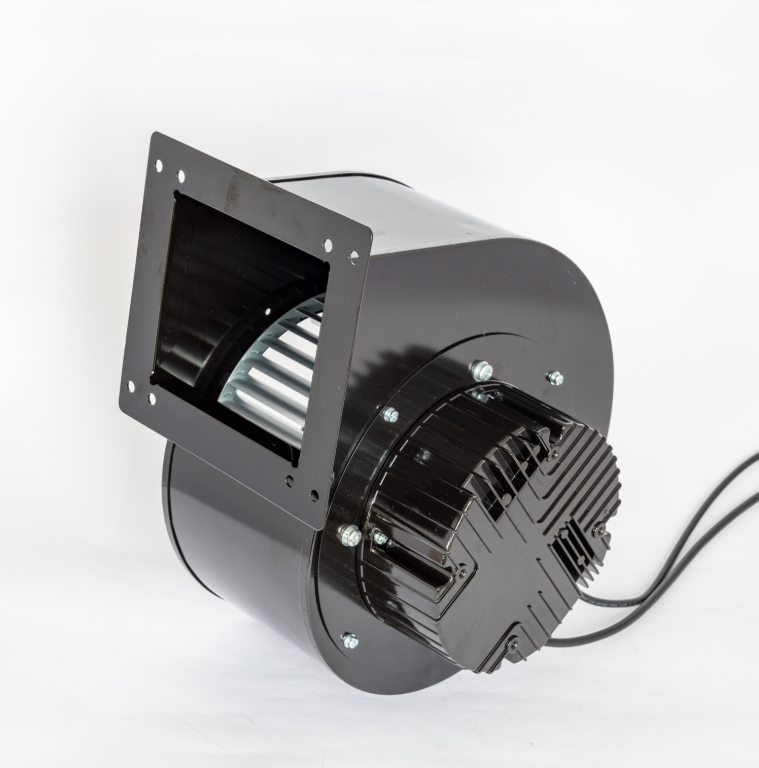
The Design Philosophy Behind the Curved Blade
A forward curved centrifugal blower operates on a principle that initially seems counterintuitive compared to its backward inclined cousins. Its impeller features a high number of relatively short blades that scoop air and fling it outward in the direction of rotation. This geometry creates a velocity profile where the absolute leaving velocity from the blade tip is substantially higher than the rotational speed of the impeller itself. What this means in practical terms is that for a given volume of air, the impeller can be significantly smaller in diameter and rotate at a much lower speed to generate a useful pressure rise. The physics here is worth understanding because it dictates everything about where this blower excels. The densely packed blade passages turn the airflow through a tight radius, imparting kinetic energy that then gets efficiently converted to static pressure within the expanding scroll housing. This is not just an academic distinction. It is the reason a forward curved design can produce meaningful pressure against a system restriction while spinning at speeds where a backward curved wheel would still be struggling to overcome its own inertia. The engineering trade off is that the blade passages are more sensitive to dust accumulation and the pressure curve has a distinct shape that demands thoughtful system matching, a point we will explore further.
Space Efficiency and Acoustic Signature
The most immediate advantage that draws equipment designers to a forward curved blower is its volumetric economy. Because the impeller does the work of generating high pressure at a reduced diameter, the entire blower housing can be packaged into an envelope that a backward curved or airfoil design simply cannot match for the same performance point. In a fan coil unit tucked above a ceiling or a residential air handler squeezed into a closet, this dimensional difference is the deciding factor between a design that is manufacturable and one that remains a concept on a CAD screen. The acoustic profile of this blower type is also closely tied to its geometry and rotational speed. Because the tip speed is inherently lower for a given pressure rise, the tonal noise generated by the blade passage frequency tends to sit in a lower and often less irritating frequency band. The broad spectrum sound that does exist is more of a rushing air character than a piercing whine. This matters immensely in occupied spaces where human comfort extends beyond temperature to the auditory environment. A hotel room air conditioning unit, for instance, becomes unmarketable if the blower emits a high pitched scream every time the thermostat calls for cooling. The forward curved wheel, when properly balanced and housed, delivers a more forgiving sound signature that allows interior designers and acoustical consultants to reach the ambient noise targets specified for premium spaces.
The Mechanical Logic of Speed and Drive
One of the deeper engineering advantages of the forward curved design is its operating speed range, which introduces cascading benefits throughout the entire mechanical drive train. When a fan can achieve its design pressure and flow at perhaps half the rotational velocity of an alternative impeller type, the stress on every rotating component drops significantly. The shaft deflection under load is reduced, the centrifugal forces acting on the hub and bearings are lower, and the fatigue life of the entire assembly extends outward. This low speed characteristic also directly impacts the motor selection. A slower blower can be directly coupled to a motor with fewer poles, avoiding the cost and complexity of belt drives or gear reducers in many compact applications. The motor itself can be physically smaller because it does not need to overcome the high inertia start up torque that a larger diameter, heavier impeller would demand. This cascading set of mechanical advantages means that a forward curved blower unit often weighs less, occupies less volume, and presents fewer maintenance touchpoints than a comparable performance alternative. The bearing system, in particular, benefits from the lower rotational speeds. Bearing life is exponentially related to speed and load, and by keeping both factors moderate, the forward curved design often delivers a service life between re-greasing intervals that pleases maintenance planners operating on tight budgets. The overall simplicity of the rotating assembly is a quiet testament to the design principle that elegance in engineering is about achieving the result through the gentlest possible motion.
Matching the Blower to the Load Characteristic
No discussion of advantages would be honest without examining the performance curve that defines where a forward curved blower operates correctly and where it runs into trouble. This blower type produces a characteristic curve where the pressure rises toward a peak as flow decreases, but then dips at the very low flow end before surging. This dip zone is an unstable operating region where the blower can hunt and pulsate, causing ductwork to boom and motor current to oscillate. The practical advantage, however, is that the stable portion of the curve provides a broad, usable range that is exceptionally well suited to systems with fixed or moderately varying resistance. An HVAC duct system, a HEPA filter bank in a cleanroom air purifier, or a heat exchanger with predictable pressure drop all sit comfortably in the stable operating band of a forward curved blower. When an application engineer understands this load characteristic and designs the system resistance to remain within the safe zone, the blower operates with remarkable steadiness and self regulation. As a filter loads with particulate and resistance increases over its service life, the blower naturally rides up its curve and settles at a lower flow without requiring active speed adjustment. This passive adaptability to changing filter conditions is a subtle but valuable advantage in systems where constant airflow through a progressively clogging media is desired. The key, and this is where expertise separates from guesswork, is to size the blower so that the entire operating band of the system over its lifecycle remains comfortably to the right of the peak pressure point on the curve. A supplier that provides a tested fan curve with the actual unit, not a generic catalogue chart, gives the designer the data needed to make this judgment accurately.
Material Selection and Manufacturing Precision
The aerodynamic design of a forward curved impeller places extraordinary demands on manufacturing consistency. Each of the many small blades must be uniformly attached to the shroud and hub, because even a slight variation in blade spacing or angle creates an imbalance that translates directly into vibration and premature bearing wear. The quality of the welding or riveting process along the blade edges determines whether the impeller can maintain its dimensional stability after thousands of thermal cycles and start stop events. In environments where the blower handles moist or mildly corrosive air, the metallurgical choice of the steel or the specification of a protective coating becomes the deciding factor in whether the unit looks and performs adequately after three years of continuous duty. Galvanized steel provides a baseline of protection, but applications involving coastal air or certain industrial exhausts demand stainless steel impellers, often from the 304 or 316 alloy families, to avoid pitting corrosion that roughens the blade surfaces and degrades aerodynamic efficiency over time. The balancing process is equally indicative of manufacturing discipline. A blower intended for quiet indoor applications should undergo dynamic balancing as a complete rotating assembly on a precision balancer, not just a static balance of the bare impeller. This process removes couple imbalances that static methods cannot detect, and the result is a blower that spins with a level of smoothness that protects the bearings and minimizes structure borne vibration transfer to the building frame. These are the behind the scenes attributes that separate a commodity blower from a unit built to a professional specification.
From Component to Integrated Solution
Selecting a forward curved centrifugal blower ultimately moves beyond comparing specifications of competing units and into the realm of supplier capability. The blower itself is a component, but the value that reaches the end user is a tested, documented, and supported assembly. An engineering team that understands how their blower interacts with the system it will join can provide the performance data, the dimensional interfaces, and the application guidance that prevent costly prototyping errors. This is where the choice of a manufacturing partner becomes a strategic decision for an equipment builder. A supplier that invests in in house dynamometer testing, maintains traceable quality records for each production batch, and has the engineering depth to suggest modifications for unusual duty cycles offers a reliability proposition that goes beyond a simple bill of materials. Fanova Motor operates within this philosophy, bridging the gap between precise impeller fabrication and the practical integration challenges faced by HVAC and air handling equipment manufacturers. The combination of verified aerodynamic performance, consistent manufacturing quality, and responsive technical support ensures that the blower specified in the design phase arrives as expected and performs as modeled. This integrated approach to supply allows a design team to focus on system level innovation, secure in the knowledge that the air moving component at the heart of their machine will not become a source of field failures or customer complaints.