EN
EN


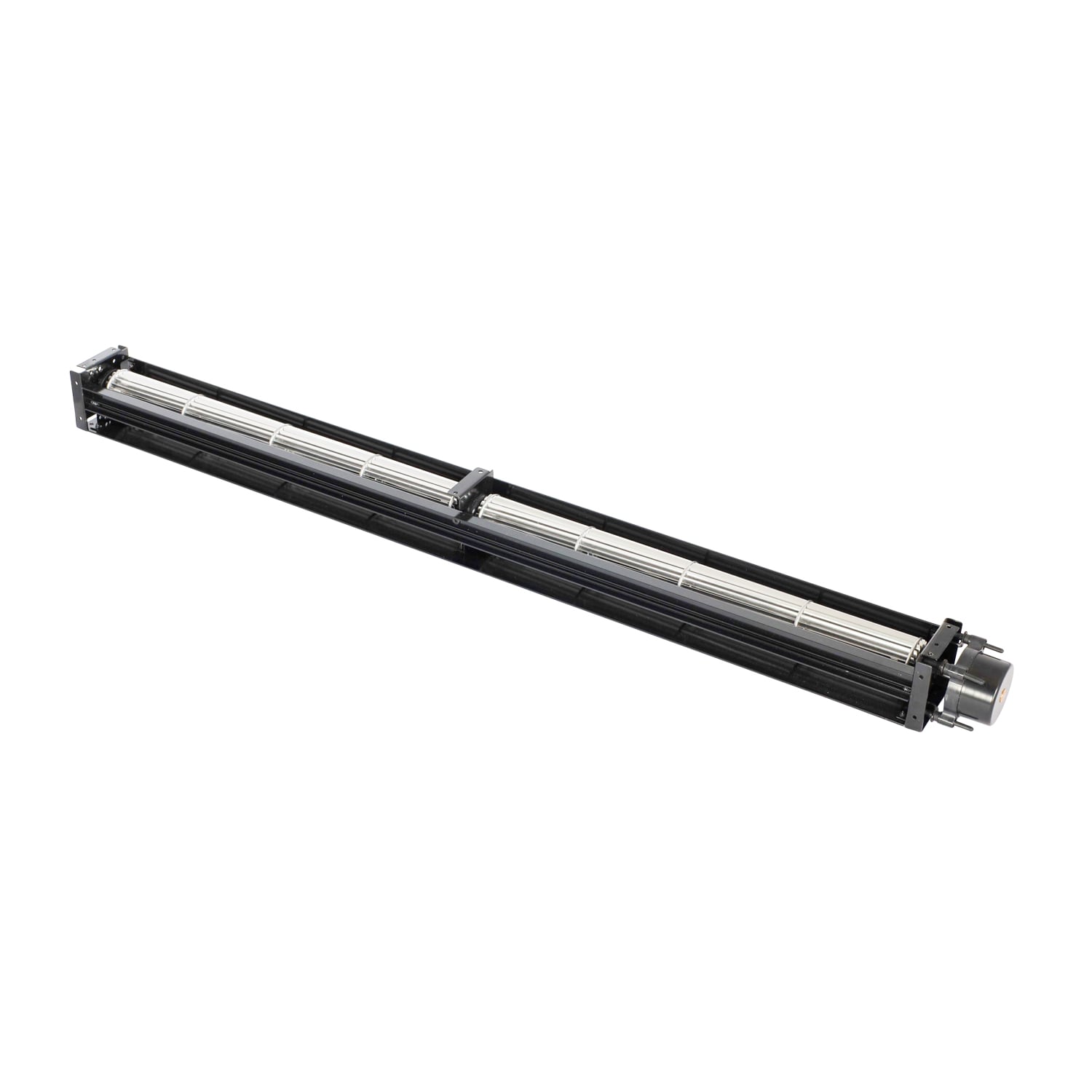
Cross-flow fan, also known as tangential fan, is a unique type of fan characterized by the gas flow direction being perpendicular to the fan's axis and passing through the impeller transversely. Unlike traditional centrifugal or axial fans, which have distinct inlet and outlet directions aligned with or parallel to the impeller axis, the cross-flow fan operates with a more unconventional airflow path that gives it specific performance advantages. This design feature makes it particularly suitable for applications requiring a uniform and wide airflow distribution, as the transverse flow pattern allows the gas to cover a larger area compared to fans with concentrated airflow.
In terms of airflow dynamics, the gas enters the impeller from one side in a radial direction, meaning it flows toward the center of the impeller along a path perpendicular to the axis. As the impeller rotates, the gas is guided through the internal channels of the impeller, undergoing a process of pressure increase and flow regulation. During this process, the impeller's blades, which are typically long and cylindrical, work to accelerate the gas while maintaining a stable flow state. Finally, the gas is discharged from the other side of the impeller also in a radial direction, forming a flat, uniform airflow sheet. This flat airflow is one of the most prominent features of cross-flow fans, as it can cover a wide area without the need for additional airflow diffusion devices.
Regarding the angle between the air inlet and outlet directions, cross-flow fans usually have an included angle of 90 degrees or 180 degrees. The 90-degree angle design is commonly used in applications where the airflow needs to be redirected from a horizontal to a vertical direction or vice versa, such as in some air curtain systems installed above doorways. The 180-degree angle design, on the other hand, allows the airflow to be reversed in direction, making it suitable for scenarios where the fan needs to supply or exhaust air from opposite sides, such as in certain air purifiers with bidirectional airflow functions. This flexibility in inlet and outlet angles enables cross-flow fans to adapt to a variety of installation environments and airflow requirements, enhancing their versatility in different application fields.
This type of fan boasts several key characteristics that set it apart from other fan types, including uniform air outlet, compact size, and low noise. The uniform air outlet is primarily attributed to the transverse flow design of the impeller, which ensures that the gas is evenly distributed across the entire width of the impeller during the flow process. This uniform airflow is crucial in applications where consistent air distribution is required, such as in air curtains, where it is necessary to form a continuous and uniform air barrier to prevent the exchange of indoor and outdoor air. The compact size of cross-flow fans is a result of their integrated impeller and housing design, which allows the fan to occupy a small space while maintaining a relatively large airflow output. This compactness makes them ideal for installation in environments with limited space, such as in the interior of air purifiers or underfloor heating ventilation systems.
The low noise performance of cross-flow fans is another significant advantage, which is achieved through a combination of factors. Firstly, the uniform airflow reduces the turbulence of the gas during flow, thereby minimizing the aerodynamic noise generated by airflow disturbance. Secondly, the design of the impeller blades, which are often optimized for aerodynamic efficiency, reduces the noise caused by the interaction between the blades and the gas. Additionally, the enclosed housing of the cross-flow fan helps to isolate and absorb part of the noise generated by the impeller rotation, further reducing the overall noise level. This low noise feature makes cross-flow fans suitable for use in indoor environments where quiet operation is required, such as residential buildings, offices, and commercial spaces.
Focusing on its application areas, cross-flow fans are widely used in air curtains (also known as air doors), some air purifiers, and underfloor heating ventilation systems. In air curtain applications, cross-flow fans are the core component responsible for generating the air barrier. When installed at the entrance of shopping malls, supermarkets, hotels, or other public buildings, the air curtain formed by the cross-flow fan can effectively block the entry of outdoor hot or cold air, dust, and insects, while maintaining the indoor temperature and air quality. The uniform airflow of the cross-flow fan ensures that the air barrier is continuous and effective across the entire width of the doorway, providing optimal energy-saving and environmental protection effects.
In some air purifiers, cross-flow fans are selected for their ability to provide uniform and gentle airflow. This gentle airflow allows the air to pass through the filter elements of the air purifier at a steady speed, ensuring that the pollutants in the air are fully filtered and purified. Compared to other fans that generate turbulent airflow, the uniform airflow of cross-flow fans can improve the filtration efficiency of the air purifier and reduce the energy consumption caused by airflow resistance. Additionally, the compact size and low noise of cross-flow fans make them suitable for integration into the compact structure of air purifiers, without affecting the overall appearance and operation noise of the device.
In underfloor heating ventilation systems, cross-flow fans play an important role in distributing the heated air evenly throughout the room. Underfloor heating systems typically heat the air at the bottom of the room, and the cross-flow fan is used to circulate this heated air to the upper parts of the room, ensuring a uniform temperature distribution across the entire space. The compact size of the cross-flow fan allows it to be installed in the narrow space under the floor, while its low noise performance ensures that the operation of the ventilation system does not cause disturbance to the indoor environment. Moreover, the uniform airflow of the cross-flow fan helps to avoid local overheating or cold spots in the room, improving the comfort of the underfloor heating system.
In addition to the aforementioned main application areas, cross-flow fans also have potential applications in other fields, such as in automotive air conditioning systems, where their compact size and uniform airflow can help to improve the cooling and heating efficiency of the air conditioning system. They are also used in some industrial drying equipment, where the uniform airflow is required to ensure that the materials are dried evenly. With the continuous advancement of technology, the design and performance of cross-flow fans are constantly being optimized, and their application scope is expected to expand further in the future.
Overall, the cross-flow fan, with its unique transverse flow design, offers distinct advantages of uniform air outlet, compact size, and low noise. These advantages make it an ideal choice for a variety of applications, particularly in air curtains, air purifiers, and underfloor heating ventilation systems. As the demand for energy-saving, high-efficiency, and low-noise ventilation equipment continues to grow, the cross-flow fan is likely to play an increasingly important role in the field of ventilation and air conditioning, contributing to the improvement of indoor air quality and energy efficiency.