 EN
EN

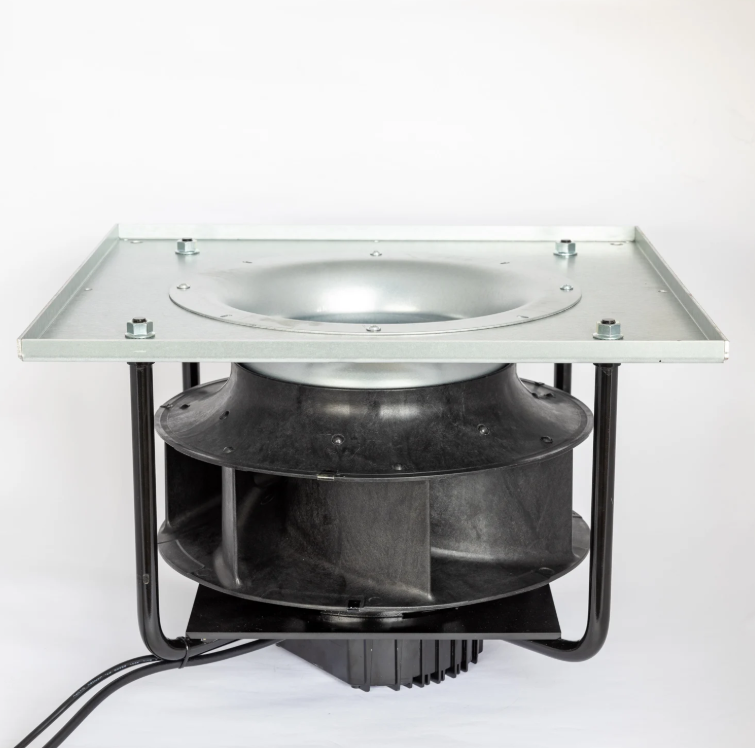
The Aerodynamic Logic of High-Pressure Performance
A backward curved blade fan earns its place in high-pressure systems through a fundamental difference in how it transfers energy from the motor shaft to the airstream. The blade tips curve away from the direction of rotation, and this geometry produces a velocity triangle at the impeller exit where the absolute leaving velocity is notably lower than what a forward curved wheel would produce at the same tip speed. This might initially sound like a disadvantage until you consider where the energy actually ends up. A forward curved design accelerates the air to a high velocity and then relies heavily on the scroll housing to convert that kinetic energy into static pressure. The backward curved approach does more of the pressure building right at the blade passage itself. The air leaves the impeller with a smaller velocity component and a larger static pressure component already established. This means less conversion work falls on the volute, and the overall stage efficiency climbs. For a system that must push air through long duct runs, dense filter banks, or across heat exchanger coils with tight fin spacing, this difference is decisive. The impeller is simply a more effective compressor of gas when measured by its ability to generate static lift against a given restriction. The blade shape also produces a steeply rising pressure characteristic from the shutoff point, giving the system designer a wide and stable operating band between the peak efficiency point and the maximum pressure condition that a forward curved wheel cannot approach without entering deep surge.
The Non-Overloading Power Curve and Motor Safety
Perhaps the most valued engineering attribute of a backward curved centrifugal fan is its power characteristic, which fundamentally protects the drive motor across all possible operating conditions. A forward curved fan exhibits a power curve that rises continuously as airflow increases. Open the damper wider, allow more flow, and the motor draws more and more current until it potentially trips its thermal overload or burns out if the system resistance falls below the design assumption. A backward curved fan reverses this behavior. The power consumption rises to a peak near the best efficiency point and then levels off or even declines as the flow increases further toward free delivery. This is called a non-overloading power curve, and it is a safety feature embedded in the aerodynamics itself. In a real industrial installation, this characteristic provides a margin against field mistakes. If a commissioning technician leaves an access door open, or if a filter bank gets removed for cleaning and the system resistance temporarily collapses, the fan simply moves more air without the motor current spiraling out of control. The motor, contactor, and upstream electrical protection remain within their design envelope without requiring an oversized safety factor on every component. This inherent self-limiting behavior reduces the risk of nuisance tripping and unplanned downtime, a reliability advantage that operations managers quickly learn to appreciate once they have experienced the alternative.
Efficiency Under Sustained System Load
High-pressure applications are rarely intermittent. A dust collection system in a woodworking plant, a combustion air supply for an industrial burner, or a pneumatic conveying line often runs for multiple shifts without stopping. In these contexts, the efficiency of the fan at the actual operating point becomes a direct multiplier on the plant's electricity bill over years of service. The backward curved design achieves its peak efficiency at a higher pressure coefficient than other centrifugal types, and more importantly, the efficiency curve tends to be relatively flat around that peak. This means that minor variations in system resistance, such as a baghouse filter loading up between pulse cleaning cycles, do not push the fan into a steep efficiency penalty. The fan continues to operate within a few percentage points of its best efficiency point even as conditions fluctuate. This operational efficiency translates directly to absorbed shaft power and therefore to kilowatt-hours consumed. When a facility manager evaluates the lifecycle cost of a fan installation, the purchase price of the hardware is quickly eclipsed by the cumulative energy cost. A backward curved fan that maintains its efficiency under real, slightly imperfect field conditions delivers a total cost of ownership that makes its selection the financially disciplined choice for any process that runs more than a few hours per day. The engineering team that specifies such a fan is effectively making a long-term investment on behalf of the operating budget.
Structural Integrity at Elevated Speeds and Temperatures
The operational speed range of a backward curved impeller introduces mechanical demands that separate properly engineered units from commodity products. To generate the tip speeds required for high-pressure duty, these impellers often rotate significantly faster than their forward curved counterparts of equivalent diameter. The centrifugal stresses acting on the blade roots, the shroud, and the hub increase with the square of the rotational speed. A blade that is simply welded along its edge and left unsupported can develop fatigue cracks that propagate from the weld toe into the parent material. The structural response from a serious manufacturer involves continuous seam welding, the use of backing rings at the hub interface, and sometimes the inclusion of a full backplate design that supports each blade along its entire trailing contour. Material selection also narrows as the application demands grow. Impellers fabricated from standard galvanized steel may suffice for clean air at moderate temperatures, but a high-pressure unit handling hot exhaust or mildly corrosive process gas requires a metallurgical upgrade. Stainless steel alloys, particularly those in the austenitic family, provide the combination of tensile strength at elevated temperature and resistance to intergranular corrosion that keeps an impeller dimensionally stable through years of thermal cycling. The hub to shaft connection deserves specific attention because this single joint transmits all the torque and supports the entire rotating mass. A taper lock bushing design that achieves a true interference fit over the shaft keyway eliminates the fretting corrosion and microscopic movement that eventually wallow out a poorly fitted bore. These structural details are invisible once the fan is assembled, but they determine whether the unit requires a bearing replacement at five years or continues running quietly toward its second decade of service.
Acoustic and Flow Quality at the Discharge
The sound and flow characteristics of a backward curved fan present both a design challenge and a qualitative advantage, depending on how the housing is engineered. The higher tip speeds necessary for high-pressure operation generate a tonal signature that is inherently louder at the blade passage frequency than a slower running forward curved unit. The tone is sharper, and it demands attention to inlet and discharge attenuators when the fan is installed in a noise-sensitive environment. However, the trade off arrives in the quality of the flow field leaving the impeller and entering the scroll. The backward curved blades produce a more organized exit flow with less boundary layer separation and turbulence than the densely packed, highly cambered passages of a forward curved wheel. This cleaner aerodynamic profile allows the scroll housing to act as an effective diffuser, converting residual velocity into static pressure with less turbulence and less of the broad spectrum noise that accompanies chaotic flow separation. The shape of the scroll cut off and the expansion angle of the discharge become critical tuning elements. A properly designed scroll, with a cut off clearance that balances pressure pulsation against recirculation losses, can quiet the unit significantly without sacrificing performance. A manufacturer that invests in computational fluid dynamics analysis and in house sound chamber testing refines these geometric parameters beyond what a standard catalogue design can offer. The resulting fan delivers not just pressure and flow, but a predictable acoustic behavior that allows the system integrator to confidently predict the sound level at the property boundary or the operator workstation.
The Value of an Engineered Air Moving Package
A backward curved centrifugal fan destined for a high-pressure system is rarely a standalone commodity item. It arrives as part of an engineered package that includes the motor, the drive arrangement, the inlet cone, the vibration isolation, and very often an application-specific coating or material specification. The value delivered to the end user is therefore not just the geometry of a set of blades but the integration competence of the supplier who assembled the package. An experienced manufacturer provides the tested fan curve for the exact unit, not a generic family curve, and that data becomes the basis for system commissioning and troubleshooting. The supplier's willingness to conduct a factory acceptance test, to balance the rotating assembly to a specified grade, and to document the material certifications for pressure-containing components signals a level of professional discipline that aligns with the expectations of industrial plant engineering standards. Fanova Motor operates within this framework, bringing together precise impeller fabrication, motor matching expertise, and a quality documentation process that supports the demands of high-pressure air handling applications. When a dust collector OEM or a process plant engineer specifies a fan from a supplier with this integrated capability, the benefit is not limited to the aerodynamic performance at the design point. The broader return includes predictable delivery, consistent unit-to-unit quality, and the engineering support to address the inevitable field adjustments that arise during commissioning. This combined offering makes the fan selection a reliable decision rather than a calculated risk.