 EN

Aerodynamic Principles of Centrifugal Pressure Generation
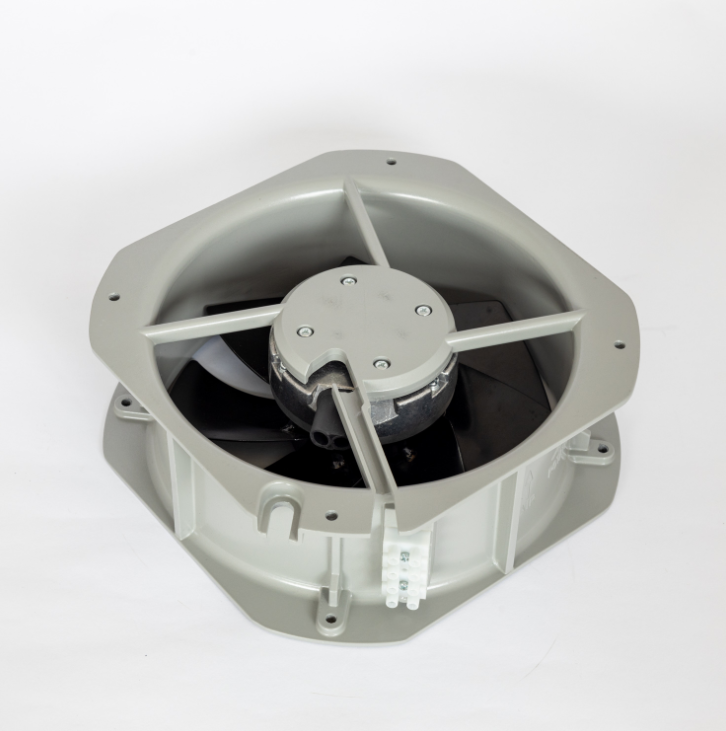
Moving air through an open window requires minimal mechanical effort, yet pulling contaminated airstreams through dense filter banks and winding sheet-metal ductwork demands serious static pressure. A radial exhaust fan solves this fluid-dynamics problem by redirecting airflow ninety degrees from the central intake hub toward the outer perimeter of a rotating impeller. As the impeller spins, centrifugal force accelerates air molecules outward along the blades, converting kinetic velocity into high static pressure inside the surrounding volute housing or open plenum. In contrast to standard axial propellers that stall whenever downstream resistance spikes, radial impellers maintain steady mass flow even when pushing against clogged particulate filters or long exhaust risers. According to AMCA 210 laboratory methods for aerodynamic testing and ISO 5801 industrial fan performance standards, centrifugal geometries generate steep pressure-volume curves that prevent backflow in high-impedance duct networks. Depending on whether the blades curve forward in the direction of rotation, angle backward, or extend straight out from the hub, engineers can tune the air-moving assembly for compact enclosure cooling, cleanroom filtration, or particulate-laden industrial extraction.
Core Industrial, Medical, and Commercial Deployment Scenarios
Because radial airflow architectures handle high static pressure so reliably, facility engineers integrate these units across a diverse spectrum of machinery, infrastructure, and environmental systems:
-
Air purification and cleanroom HVAC units: Backward-curved centrifugal impellers sit directly behind high-efficiency particulate air filters in medical laboratories, pharmaceutical suites, and commercial air handlers, maintaining uniform laminar airflow as filter media gradually loads with dust.
-
Industrial machinery and cabinet thermal management: Compact volute blowers and motorized impellers extract trapped waste heat from high-frequency power inverters, automated laser cutters, and telecom rectifier racks where tightly packed electronics block straight-through axial breezes.
-
Fume extraction and dust collection networks: Straight-bladed radial wheels and ruggedized centrifugal blowers pull welding smoke, grinding swarf, and woodworking sawdust through local exhaust hoods without allowing sticky fibers to build up along the blade surfaces.
-
Transportation and commercial appliance ventilation: Low-profile centrifugal blowers circulate conditioned air inside railway passenger coaches, cold-chain refrigeration cases, and commercial convection ovens where mounting depth is strictly limited.
Performance Comparison Across Radial Impeller Geometries
Selecting the proper radial configuration requires matching blade orientation to airstream cleanliness, acoustic limits, and static pressure resistance.
| Impeller Configuration | Static Pressure Capability | Particulate Fouling Resistance | Acoustic Noise Profile | Non-Overloading Motor Behavior | Typical System Integration |
|---|---|---|---|---|---|
| Backward-Curved Centrifugal | High pressure across wide flow range | Moderate, best for filtered air | Low aerodynamic turbulence | True non-overloading power curve | Cleanroom FFUs, HVAC plenums, medical air purifiers |
| Forward-Curved Volute Blower | Moderate pressure at compact size | Low, curved scoops trap sticky dust | Quiet at low tip speeds | Power draw rises with free delivery | Telecom cabinets, home appliances, vehicle HVAC |
| Straight-Bladed Radial Wheel | Very high pressure at low volume | Excellent self-cleaning blade face | High blade-passing tone | Requires careful damper sizing | Local dust extraction, pneumatic material conveying |
The engineering comparison above highlights an important operational boundary: while forward-curved volute fans deliver impressive airflow from a tiny footprint, exposing their shallow curved blades to greasy kitchen fumes or fibrous workshop dust quickly throws the rotor out of dynamic balance.
Field Lessons from an Ohio Precision Machining Plant Retrofit
Mismatching impeller geometry and motor control to real-world duct conditions often leads to chronic maintenance headaches. During an environmental ventilation upgrade at a precision metalworking and electronics assembly facility in central Ohio, plant engineers struggled with recurring motor burnouts on six centralized mist-and-fume extraction units. The original equipment utilized belt-driven forward-curved blowers powered by fixed-speed alternating-current induction motors. Over several months of operation, microscopic coolant droplets and fine metallic dust coated the curved impeller scoops, adding rotational mass while simultaneously restricting the primary bag filters downstream. As static pressure climbed inside the ductwork, the fixed-speed motors hunted along an unstable stall region of the fan curve, vibrating violently until the drive belts snapped or thermal overloads tripped. Replacing those legacy belt-driven blowers with direct-drive backward-curved radial exhaust fan assemblies powered by electronically commutated motors resolved the bottleneck. Because the steep backward-curved blades shed oil mist naturally and the integrated brushless motor electronics automatically adjusted rotational speed to compensate for filter loading, the facility eliminated belt maintenance while stabilizing negative pressure at every workstation hood.
Electronically Commutated Motors and Sourcing Reliable Fan Solutions
Modern industrial ventilation increasingly moves away from bulky external induction motors and V-belts toward integrated electronically commutated external-rotor designs. By mounting permanent magnets directly inside the rotor hub that carries the impeller blades, the motor sits directly within the cooling airstream while eliminating shaft couplings and transmission losses. Built-in pulse-width modulation and analog speed control inputs allow building management systems to ramp exhaust rates up or down smoothly in response to real-time air quality sensors. Furthermore, advanced glass-fiber-reinforced engineering plastics allow modern impellers to achieve complex three-dimensional aerodynamic blade twists that stamped sheet metal cannot replicate, cutting rotor weight and starting torque strain.
For equipment manufacturers, HVAC systems integrators, and industrial facility planners seeking dependable air-moving hardware, Fanova brings over two decades of specialized engineering across EC centrifugal fans, axial fans, and volute blowers. Supported by dedicated aerodynamic research teams, custom plastic material development, and automated production lines, the manufacturing team delivers customizable, energy-conscious wind-power solutions tailored for purification, ventilation, medical, transportation, and machinery applications worldwide.
Table of Contents
- Aerodynamic Principles of Centrifugal Pressure Generation
- Core Industrial, Medical, and Commercial Deployment Scenarios
- Performance Comparison Across Radial Impeller Geometries
- Field Lessons from an Ohio Precision Machining Plant Retrofit
- Electronically Commutated Motors and Sourcing Reliable Fan Solutions