 EN

Why the EC Centrifugal Blower Changes the Control Conversation
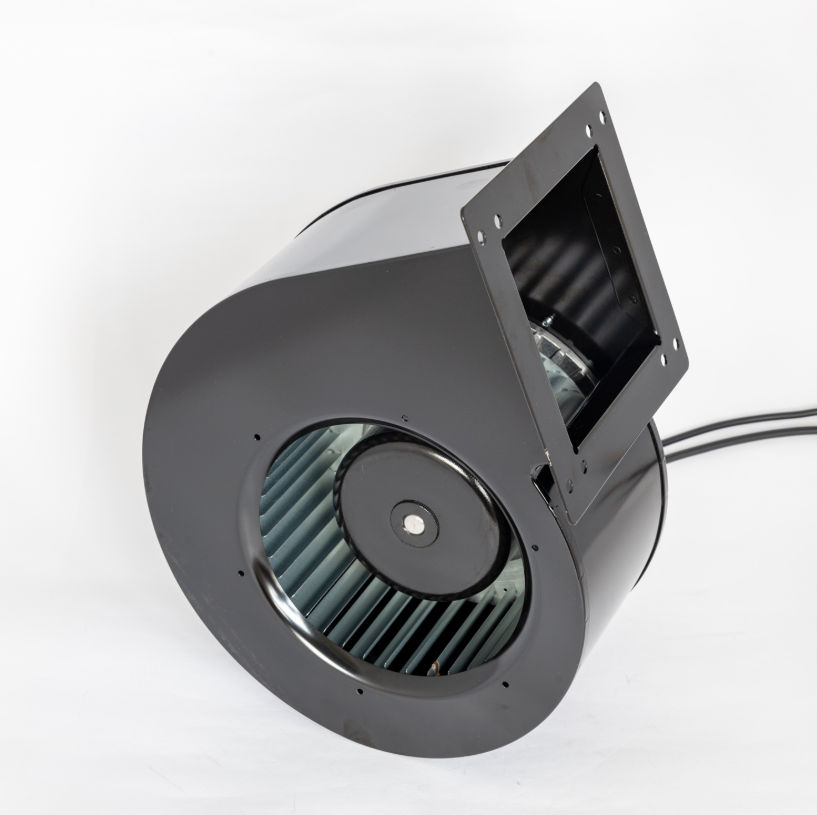
An ec centrifugal blower is not just a centrifugal fan with a different motor bolted on. The useful difference sits in how airflow, pressure, and motor speed are managed as a system. A conventional belt-driven centrifugal fan often runs at a fixed speed, and the air path is trimmed with dampers, inlet vanes, or mechanical sheaves. That approach works, but it wastes energy by adding resistance or by running the impeller faster than the duty point requires. An EC centrifugal fan couples a brushless, electronically commutated motor with onboard speed control, so the impeller tracks the actual demand instead of a single design point. For HVAC, purification, and process ventilation, that shift changes startup behavior, part-load stability, and the way a project team commissions the air side.
Where the Real Savings Come From in Part-Load Operation
Part-load operation is where the economics usually show up. A fan rated for peak flow may spend most of the year at 50% to 70% of design airflow, especially in buildings with variable occupancy or filters that load gradually. With damper control, the fan keeps spinning near full speed while the damper burns pressure. With speed control, power demand falls roughly with the cube of speed for a fixed system curve, though real duct systems, motor losses, and control settings keep the result from being a perfect cube law. The practical point is simple: reducing speed usually reduces power far more than throttling does. Integrated EC control also allows pressure or airflow setpoints to be adjusted in small steps, which matters when a cleanroom or paint booth needs stable differential pressure.
A Practical Comparison for Retrofit and New Build Teams
| Decision area | AC belt-driven centrifugal fan | EC centrifugal blower | Why it matters |
|---|---|---|---|
| Speed control | Fixed speed or mechanical sheaves; VFD adds separate panel | Integrated electronic speed control | Fewer coordination points at commissioning |
| Part-load response | Damper or inlet vane throttling | Direct speed turndown, often 3:1 or wider | Better match to variable demand |
| Setpoint stability | Pressure swings during filter loading | Closed-loop pressure or airflow control | Less manual rebalancing |
| Maintenance points | Belts, pulleys, bearings, tension checks | Fewer mechanical drive parts | Lower routine inspection burden |
| Retrofit footprint | Requires belt guard and alignment space | Compact motor-impeller package | Useful in tight mechanical rooms |
| Acoustic behavior | Belt and bearing noise at low load | Lower mechanical noise, tonal character varies | Needs careful octave band review |
What a Chemical Plant Retrofit Revealed About Filter Loading
A retrofit at a chemical plant in southern China offered a useful reality check. The existing belt-driven centrifugal fan served an acid mist scrubber and ran at fixed speed. Operators had been opening a bypass damper as the filter loaded, which kept the scrubber online but made pressure control sloppy. The project team replaced the drive package with an EC centrifugal blower and tied the speed command to a differential pressure transmitter across the filter bank. During commissioning, the fan speed rose in small increments as the filters loaded, and the pressure band stayed tighter than the old manual routine. The team also found that the old belt guard had been hiding a misalignment issue, a reminder that retrofit savings can disappear if duct leakage and damper leakage are ignored. The lesson was not that every fan should be replaced. It was that sensor location, filter loading behavior, and control deadband need to be checked before anyone promises a clean payback.
The Limits That Deserve Honest Attention
EC centrifugal blowers are not a universal answer. Electronics need a clean, dry, and thermally managed enclosure, and high ambient temperatures can force derating or a different motor insulation class. Harmonics and electromagnetic compatibility need review when many drives sit on the same distribution board. Fan performance should be compared on a common basis, such as AMCA 210/ASHRAE 51 test data, not on bare motor efficiency alone. Motor efficiency classes under IEC 60034-30-1 help separate motor quality from fan system performance, but the impeller, housing, and airflow path still determine the delivered duty point. In corrosive or dusty streams, the motor and electronics may need to sit outside the airstream, which changes the package size and service access. Honest specification means checking turndown, static pressure, sound power by octave band, and the actual control signal available from the building management system.
How to Specify and Source Without Getting Lost in Acronyms
A sound specification starts with the duty point and the control story, not with a catalog headline. Define the airflow and static pressure range, the required turndown, the sensor type, the acceptable sound levels at the occupied space, and the electrical environment. Ask for fan curves that include the selected impeller and housing, not just motor data. For projects with variable filters or variable occupancy, request a part-load control narrative that explains how the setpoint is maintained and what happens when a sensor fails. Fanova, a Suzhou-based EC fan manufacturer, supports these conversations with in-house design, tooling, and production for EC centrifugal fans, axial fans, and volute fans, which helps keep prototype iterations, quality checks, and supply planning aligned for industrial, commercial, and household air systems.
Table of Contents
- Why the EC Centrifugal Blower Changes the Control Conversation
- Where the Real Savings Come From in Part-Load Operation
- A Practical Comparison for Retrofit and New Build Teams
- What a Chemical Plant Retrofit Revealed About Filter Loading
- The Limits That Deserve Honest Attention
- How to Specify and Source Without Getting Lost in Acronyms