 EN

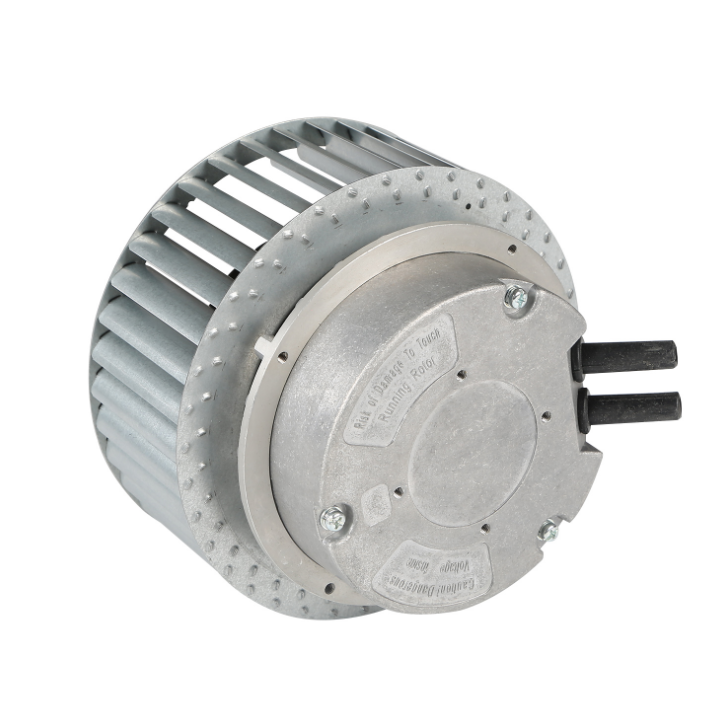
Matching Static Pressure Curves Against Filter Media Loading
Selecting an air-moving assembly for filtration equipment starts with a harsh aerodynamic reality: clean filters and dirty filters behave like two completely different duct systems. When an engineer specifies an ec fan for air purification units, calculating airflow solely against the initial resistance of a fresh glass-fiber filter cartridge guarantees system failure within months. Under ISO 29463 and EN 1822 testing standards for high-efficiency particulate air filters, dense pleated media introduces substantial initial static impedance, and that pressure drop doubles as microscopic dust cakes across the fiber matrix. Standard axial propellers and low-pressure blowers hit an aerodynamic stall wall as soon as static pressure climbs, causing clean air delivery rates to plummet. Backward-curved centrifugal impellers solve this bottleneck by generating steep, non-overloading pressure-volume curves. Even when a multi-stage filtration bank combines pre-filters, activated carbon beds, and final HEPA membranes, a properly sized centrifugal wheel maintains positive mass flow across the entire filter lifecycle without surging or drawing excessive amperage.
Acoustic Engineering and Sinusoidal Motor Commutation
Air purifiers frequently operate right beside human ears inside hospital recovery wards, residential bedrooms, corporate boardrooms, and university laboratories. In these quiet environments, decibel ratings matter just as much as cubic feet per minute. Noise inside a filtration unit originates from two distinct sources: aerodynamic blade turbulence and electromagnetic motor commutation. Managing both acoustic pathways requires evaluating three hardware design details:
-
Field-oriented sinusoidal drive electronics: Older brushless motors utilizing trapezoidal block commutation produce an audible high-frequency ticking or magnetic hum at low speeds, whereas sine-wave vector controllers switch stator phases smoothly for whisper-quiet operation.
-
Three-dimensional molded blade geometry: Impellers injection-molded from glass-fiber-reinforced engineering plastics incorporate swept entry edges and aerodynamic winglets that slice through intake air without shedding loud vortex eddies.
-
Dynamic rotor balancing across the full speed range: Precision two-plane factory balancing prevents resonant cabinet rattle when the blower ramps down to night-mode sleep settings.
Impeller and Motor Architecture Comparison for Filtration Systems
Different purification form factors demand distinct airflow paths. A ceiling-mounted cleanroom fan filter unit has completely different spatial constraints than a slim freestanding residential tower purifier.
| Fan Architecture | Static Pressure Reserve | Acoustic Profile at Low Speed | Spatial Footprint | Typical Filtration Integration |
|---|---|---|---|---|
| EC Backward-Curved Centrifugal | High, overcomes dense HEPA and ULPA media | Very low tonal noise in open plenums | Compact axial depth, wide radial discharge | Ceiling FFUs, medical isolation units, commercial air handlers |
| EC Forward-Curved Volute Blower | Moderate, suited for Electrostatic and MERV media | Quiet at low RPM, turbulent at peak flow | Directed rectangular duct outlet | Ducted residential purifiers, under-counter fume extractors |
| EC Mixed-Flow & Axial Impeller | Low to moderate static pressure capacity | Noticeable blade-passing tone under backpressure | Slim inline cylindrical profile | Pre-filter booster ducts, high-volume workshop dust collectors |
The technical comparison above demonstrates why backward-curved motorized impellers dominate high-grade medical and semiconductor filtration, while compact volute blowers remain popular inside slim household and commercial appliance housings where airflow must turn into a narrow discharge grille.
Field Lessons from a New Jersey Cleanroom FFU Upgrade
Overlooking closed-loop speed control and bearing durability can turn a cleanroom certification audit into an expensive crisis. During a facility expansion at a sterile compounding and electronics research laboratory in central New Jersey, engineering managers installed eighty ceiling-mounted fan filter units powered by voltage-controlled alternating-current motors. Within nine months of continuous operation, particulate counters began flagging ISO 14644-1 cleanliness deviations in three primary preparation zones. A diagnostic walk-through revealed that as the ceiling filters captured ambient particulates, static resistance rose steadily, causing the AC motors to slow down and drop laminar face velocity below regulatory thresholds. Worse yet, technicians had to climb into the ceiling plenum every six weeks to manually adjust transformer taps on individual units to restore airflow, while radiant heat from the inefficient motor housings warmed the conditioned room air below. Retrofitting the ceiling grid with backward-curved EC centrifugal fans equipped with RS-485 networking and closed-loop constant-airflow algorithms eliminated the manual balancing labor. As filter resistance increased over time, the onboard microprocessor automatically sensed the torque shift and increased rotational speed incrementally to hold exact laminar velocity, while cutting electrical consumption and plenum heat buildup across the laboratory.
Material Compatibility and Sourcing Customizable Fan Assemblies
While electronically commutated blowers excel across most filtration architectures, engineers must still respect environmental boundaries. In industrial scrubbers extracting corrosive acid vapors or volatile solvents, standard exposed circuit boards and steel bearings will degrade prematurely unless isolated from the airstream or treated with specialized conformal coatings. Similarly, high-humidity hospital sterilization suites require moisture-protected potting around the stator windings. For mainstream medical infrastructure, commercial HVAC purification, home appliances, and cleanroom equipment, matching custom-molded plastic impellers with intelligent external-rotor motors provides the ideal balance of static pressure, acoustic comfort, and compact integration.
For air purifier OEMs, cleanroom systems integrators, and ventilation equipment brands seeking dependable wind-power components, Fanova brings over two decades of specialized R&D across EC centrifugal fans, axial fans, and volute blowers. Supported by advanced plastic material exploration, optimized motor design, and rigorous aerodynamic testing facilities, the engineering team delivers tailored, low-noise fan solutions built to meet evolving air purification demands across global industrial, commercial, and household markets.