 EN
EN

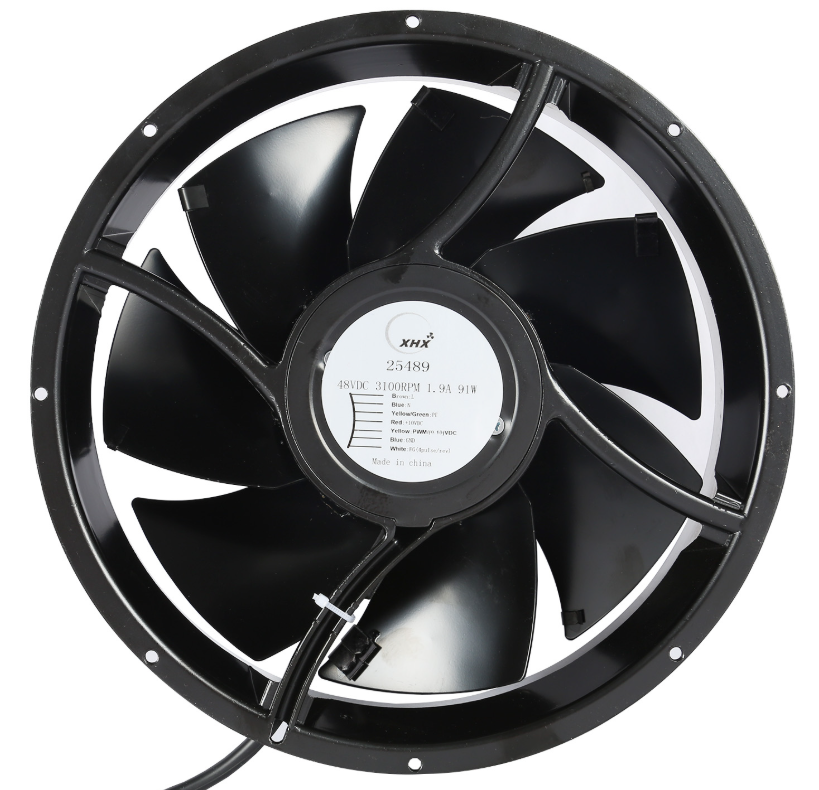
Why Electronics Need Active Cooling
Modern electronics pack an enormous amount of processing power into increasingly compact enclosures. Servers, network switches, power supplies, AV equipment, and industrial controllers all generate heat as a byproduct of doing their job. That heat has to go somewhere, or component temperatures rise until performance throttles or permanent damage occurs. Natural convection works for low power devices with generous enclosures, but anything with real processing capability needs active airflow to stay within safe operating limits. A brushless axial fan has become the standard solution for moving that air efficiently, quietly, and reliably.
The Brushless DC Motor Advantage
The "brushless" part of the brushless axial fan is what makes it suitable for electronics cooling in the first place. Traditional brushed DC motors use physical brushes and a commutator to switch the magnetic field, which creates friction, sparking, and wear that limit the motor's life. A brushless motor replaces that mechanical switching with electronic commutation. The absence of brushes means no friction, no sparking, no brush dust, and dramatically longer operating life. For electronics applications, the spark free operation matters because it eliminates electromagnetic interference that could disrupt sensitive circuits nearby. The typical brushless DC motor can run for tens of thousands of hours without failure, which aligns with the expectation that electronics cooling should just work without constant attention.
Compact Size Fits Tight Spaces
Electronics enclosures rarely offer the luxury of generous space for cooling components. A brushless axial fan addresses this with a form factor that integrates the motor into the hub and the blades into a compact cylindrical frame. Standard sizes range from tiny 25 millimeter units for small embedded systems up to larger 120 or 140 millimeter fans for server chassis and rack enclosures. The axial airflow path means the fan thickness can be as little as 10 or 15 millimeters, fitting into spaces where a centrifugal blower would not. This compact nature, combined with the ability to mount directly onto enclosure walls or ventilation panels, makes the brushless axial fan an ideal fit for the tight geometries of modern electronic equipment.
Speed Control Matches Cooling to Heat Load
Heat generation in electronics is not constant. A server ramps up under heavy computing loads. A network switch handles peak traffic at certain times of day. A motor drive dissipates more heat during acceleration. Running a cooling fan at full speed all the time wastes energy, generates unnecessary noise, and pulls dust through the enclosure. The brushless axial fan solves this with built in speed control capability. Through PWM or voltage control signals from the host system, the fan adjusts its speed to match the actual cooling demand. Temperature sensors on the PCB or in the enclosure provide feedback, and the fan speeds up only when temperatures rise. This demand based operation extends fan life, reduces power consumption, and keeps noise to a minimum during idle or light load conditions.
Reliability as a Core Requirement
In electronics cooling, reliability is not optional. A fan failure in a server can cascade into an overheating event that takes down critical systems. The brushless axial fan earns its place in these applications through robust design. The bearing system, whether ball bearings for high temperature applications or advanced sleeve bearings for quieter operation, determines much of the fan's service life. Quality brushless axial fans are rated for tens of thousands of hours of continuous operation at elevated temperatures. The integrated electronics in the motor provide locked rotor protection, which shuts the fan down safely if the blades get obstructed rather than burning out the motor. These protections ensure that the cooling system keeps running reliably year after year.
The brushless axial fan has become the backbone of electronics cooling for good reasons. Compact size, long life, clean operation, and intelligent speed control make it the right tool for keeping sensitive equipment cool in demanding environments. From tiny embedded controllers to massive server farms, this technology quietly moves the air that keeps modern electronics alive.