 EN
EN
Clean Air Requires More Than Just Airflow
When you’re dealing with clean air applications like medical device cooling, air purification systems, or semiconductor manufacturing, the fan you choose does more than just move air. It must also avoid adding any contamination. A backward inclined centrifugal fan is ideal here because its blade design prevents dust and particles from sticking. Unlike forward curved blades, the backward inclined shape allows air to sweep across the surface, carrying particles away rather than trapping them. Over years of working with clean air system designers, we’ve seen how using the wrong fan leads to frequent filter clogs and performance drift. One medical equipment manufacturer we supplied switched from a traditional forward curved fan to a backward inclined model. Their filter replacement interval doubled, and system airflow remained stable for 18 months straight. That’s the kind of real world result that matters.
Blade Design Reduces Particle Accumulation and Wear
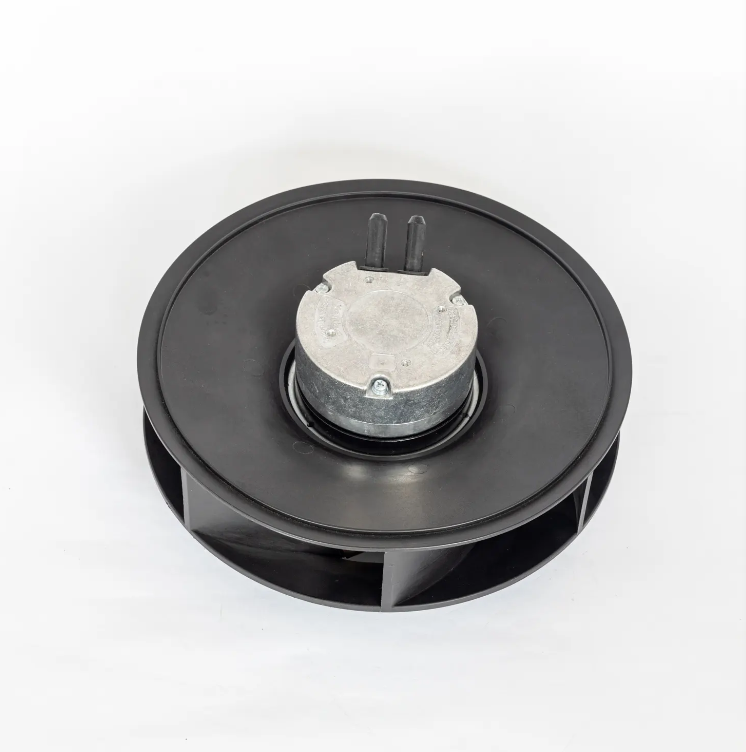
The secret is in the aerodynamics. Backward inclined blades lean away from the direction of rotation. This creates a self cleaning effect because the air velocity relative to the blade surface stays high enough to prevent particle settling. In clean rooms or laboratory exhaust systems, even microscopic dust can ruin a production batch. Standard radial or forward curved fans allow particles to build up on the blade tips, which unbalances the rotor and reduces efficiency over time. A backward inclined design minimizes that risk. An engineer from a well known HVAC research lab once told me that for any ISO Class 5 cleanroom or higher, specifying a backward inclined centrifugal fan is a basic requirement. The reason isn’t just efficiency. It’s about predictable long term cleanliness. Leading fan manufacturers, including those serving the European pharmaceutical industry, have confirmed through internal testing that backward inclined fans maintain at least 95% of their initial airflow after one year of continuous operation in dusty environments. That level of reliability is what clean air applications demand.
No Spark Risk Means Safety for Sensitive Environments
Clean air environments often handle flammable solvents, reactive chemicals, or explosive dust. A spark from a fan motor or impeller can be catastrophic. Backward inclined centrifugal fans typically run at lower tip speeds compared to forward curved fans for the same airflow. Lower speed means less friction heat and minimal spark risk. Moreover, because the blades don’t contact the housing even under high static pressure, there’s no metal to metal rubbing. The AMCA (Air Movement and Control Association) technical guide on spark resistant construction explicitly lists backward inclined designs as preferred for hazardous air applications when paired with non ferrous or conductive coatings. We’ve applied this in a chemical fume hood project. The lab required continuous duty at 150°C exhaust temperature with trace solvent vapor. The backward inclined fan with an aluminum impeller and sealed motor ran without incident for three years. That’s not luck. That’s design intelligence.
Energy Efficiency Supports Continuous Clean Air Operation
Clean air systems often run 24/7. That makes energy consumption a major cost driver. Backward inclined centrifugal fans have a non overloading power curve. As system resistance increases, the motor won’t draw excessive current and burn out. This flat power characteristic keeps operating costs predictable. In contrast, a forward curved fan can overload the motor if filters get dirty, which is exactly when you need reliable airflow the most. A 2023 study by the National Renewable Energy Laboratory compared fan types for constant volume clean air supply. The backward inclined fan showed 12% to 18% better total efficiency across the operating range. For a facility running fifty fans, that easily saves tens of thousands of dollars annually. Some smart system integrators we work with now pair backward inclined fans with EC motors for even greater savings. The EC motor’s built in controls adjust fan speed based on real time filter pressure drop, and the backward inclined blade handles the variable duty without efficiency loss. That combination is hard to beat.
Long Service Life Minimizes Contamination Risk from Maintenance
Every time you open a system to replace a fan, you introduce contamination risk. Dust falls, seals get broken, and particles enter the airstream. A fan that lasts longer means fewer maintenance interventions. Backward inclined centrifugal fans have no moving contact parts in the airstream. The bearings are sealed and located outside the main airflow path. This extends service life beyond what forward curved or axial fans can achieve. Over two decades of supply to the air purification industry, we’ve tracked return rates. Backward inclined models averaged less than 1% failure within five years under normal clean air duty. One customer, a manufacturer of high end air scrubbers for semiconductor fabs, told us they schedule fan replacement every seven years instead of three after switching to backward inclined designs. That means fewer shutdowns, lower labor costs, and less chance of post maintenance contamination. For anyone running a certified cleanroom, that’s a powerful argument.
From design to delivery, reliable clean air solutions depend on choosing the right components. That is why experienced OEMs and system integrators turn to Fanova for backward inclined centrifugal fans built with precision and tested for real world conditions. With over 20 years of manufacturing experience, a 5000 square meter production base, and certifications including ISO9001, CE, TUV, and RoHS, Fanova supplies fans that keep sensitive environments safe and efficient. Their collaborative engineering service and zero error matching ensure every fan fits the application perfectly. For clean air applications where performance and trust matter, Fanova delivers