 EN
EN

The Fundamental Challenge of Moving Dirty Air
Dusty air streams are a constant headache in industries like woodworking, cement production, mining, and grain processing. The particles floating in these environments do not just reduce air quality for workers. They also attack the fan itself, wearing down blades, clogging internal passages, and eventually causing premature failure if the equipment is not designed for the job. A backward centrifugal fan, sometimes called a backward inclined or backward curved fan, has specific geometric features that make it far more tolerant of particle laden air than other fan types. The blades are curved away from the direction of rotation, which creates a smoother flow path and reduces the amount of material that gets trapped on the blade surface. This is not just a minor design tweak. It fundamentally changes how the fan interacts with dirty airstreams and why so many industrial engineers prefer this configuration when dust is part of the daily operating reality.
Why the Backward Curved Blade Design Resists Particle Buildup
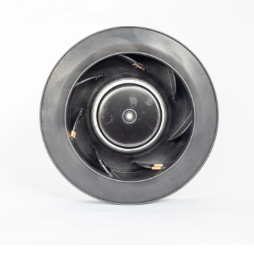
The blade geometry of a backward centrifugal fan is the core reason it handles dusty air so well. In a forward curved fan, the blades scoop air aggressively, which creates high velocity zones and turbulence near the blade surface. That turbulence makes it easier for fine particles to stick to the metal and gradually build up a layer of dust. A backward curved blade operates more like a paddle wheel moving in reverse. The air enters the impeller and is smoothly redirected outward without the same violent pressure spikes. This lower turbulence means particles are more likely to pass through the impeller without adhering to the blades. Additionally, the self cleaning nature of the backward design comes from the centrifugal forces acting on any particle that does touch the surface. Since the blades lean away from the rotation, dust and debris tend to slide off rather than embed themselves. I once visited a wood processing plant that had switched from a radial blade fan to a backward curved unit on their sawdust collection line. The maintenance team reported that the interval between manual cleanings tripled almost immediately, simply because the impeller was no longer acting like a dust trap.
Efficiency Under Load Keeps the System Running Longer
One of the less obvious advantages of a backward centrifugal fan in dusty environments is its ability to maintain efficiency even as conditions change. Dust collection systems often experience variable loading. Filters get dirty, dampers open and close, and the amount of particulate matter in the air can shift dramatically from hour to hour. A backward curved fan has a non overloading horsepower characteristic, which means the power consumption does not spike uncontrollably when the system resistance drops. This is a huge benefit in industrial settings where a sudden change in airflow can destroy a less robust fan. The impeller design also produces a steeper fan curve, allowing the system to deliver stable airflow across a wider range of pressures. For a dusty stream application, this means the fan can keep pulling air even as filters accumulate dust and static pressure rises. Operators do not have to constantly adjust the system to keep production moving. That kind of reliability translates into fewer shutdowns and more consistent output over a long production shift.
Structural Durability When Particles Act Like Sandblasting Media
Dust is not just a nuisance. At high speeds, even fine particles act like a sandblasting medium, eroding surfaces and weakening components over time. Backward centrifugal fans are often built with thicker impeller plates and more robust welding compared to lighter duty fan types. The design naturally places less stress on the blade tips because the airflow exits the impeller at a lower velocity relative to the blade. This reduces the erosive impact of particles striking the metal at aggressive angles. In many industrial applications, manufacturers also offer wear resistant coatings or replaceable liners on the blade surfaces. The combination of smart geometry and durable materials gives backward centrifugal fans a longer service life in abrasive environments. One cement plant engineer I spoke with mentioned that their backward curved fans lasted nearly twice as long as the old forward curved units on the same dusty kiln exhaust line. The cost savings from reduced replacement and downtime made the initial price difference irrelevant within the first year of operation.
Noise Reduction and Worker Comfort in Dusty Facilities
Facilities that handle dusty materials are often loud enough already without adding a screaming fan to the mix. Backward centrifugal fans tend to run quieter than their forward curved counterparts, especially at higher static pressures. The smoother airflow path and reduced turbulence inside the impeller cut down on the broadband noise that makes industrial spaces so exhausting to work in. This might seem like a secondary benefit when the main goal is moving dirty air, but it matters a great deal for long term worker health and regulatory compliance. Lower noise levels also make it easier for maintenance crews to detect other mechanical problems, like bearing wear or belt slippage, before they turn into catastrophic failures. A quieter fan in a dusty environment is not just a comfort upgrade. It is a practical advantage that supports safer and more efficient operations across the whole facility.
Matching the Fan to the Specific Dusty Application
Not every backward centrifugal fan is identical, and choosing the right one for a particular dusty stream requires some careful thought. The type and concentration of dust matters. Light wood sawdust behaves very differently from sticky cement powder or abrasive silica particles. The temperature and humidity of the air stream also affect how particles behave and whether they will clump together inside the fan. Fan manufacturers typically offer different impeller materials, coating options, and even special shaft seal arrangements for tough dusty applications. Getting these details right from the start prevents expensive retrofits later. Companies that specialize in industrial fan production understand how to match a backward curved impeller with the right housing design, motor power, and bearing system for a given set of operating conditions. That kind of engineering support is essential when the fan is going to live in a harsh environment day after day.
The Commercial Value of Choosing the Right Fan Partner
For any business dealing with dusty air streams, the choice of fan supplier is just as important as the choice of fan type. A backward centrifugal fan may be the right technical answer, but the fan must still be built correctly and matched to the specific application. Fanova has deep experience in manufacturing backward centrifugal fans for industries that handle wood dust, grain particles, mineral powders, and other challenging airborne materials. The team understands that dust is not a single problem but a family of problems with different particle sizes, moisture levels, and abrasion characteristics. By working closely with clients to define the exact operating conditions, Fanova delivers fans that resist buildup, maintain efficiency, and keep maintenance costs under control. For plant managers who are tired of cleaning clogged impellers or replacing worn out blades, that kind of focused manufacturing expertise makes a measurable difference in both equipment life and overall operating cost. The right fan in the right application is not just a purchase. It is a long term productivity strategy.
Table of Contents
- The Fundamental Challenge of Moving Dirty Air
- Why the Backward Curved Blade Design Resists Particle Buildup
- Efficiency Under Load Keeps the System Running Longer
- Structural Durability When Particles Act Like Sandblasting Media
- Noise Reduction and Worker Comfort in Dusty Facilities
- Matching the Fan to the Specific Dusty Application
- The Commercial Value of Choosing the Right Fan Partner