 EN
EN
It's kind of funny how we spend so much time thinking about motors, horsepower ratings, and control panels, but rarely stop to look at the actual part doing the heavy lifting: the blade itself. When you are dealing with moving air in a system that actually has some resistance to it, the shape and angle of those blades are not just an aesthetic choice. They are the secret sauce behind whether the whole thing runs like a dream or becomes a noisy, power hungry headache. And if you have spent any time around industrial ventilation or HVAC setups, you have definitely heard the term backward inclined blades thrown around. But what do they actually do? Why are they the go to choice when things get serious?
Here's the reality. Not all fans are created equal, and the differences come down to physics. It is about how the blade catches the air and what it does with it next. A backward inclined blades design is fundamentally different from the cheap fans you buy at the hardware store. Those cheap ones usually have blades that scoop forward, kind of like a shovel digging into dirt. That works fine for moving a lot of air quickly in an open space, but the moment you attach a duct or a filter to it, it just gives up. The backward inclined design is the opposite. It is built for efficiency and stamina, not just raw, uncontrolled volume. Understanding how these blades work under pressure is key to building a system that does not just survive but actually thrives.
The Aerodynamic Foundation of Smooth Airflow
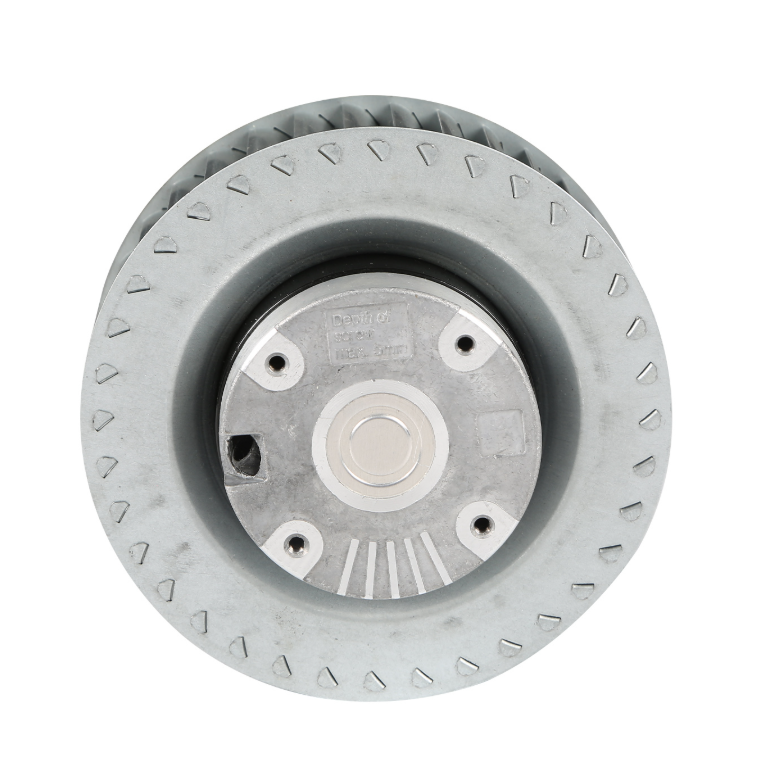
Let's break down the visual a bit. When you look at an impeller with backward inclined blades, the blades are angled away from the direction of rotation. Imagine the wheel spinning clockwise. The blades lean backwards, so the tips are trailing behind the heels. This is not a random decision someone made in a factory a hundred years ago. It is pure aerodynamics. Because the blades are oriented this way, the air gets a much smoother ride through the fan housing. Instead of being violently thrown outward like with a forward curved blade, the air is guided along a gradually expanding path.
This gradual expansion is everything. When air is forced to change direction sharply or expand too quickly, you get turbulence. Turbulence is the enemy. It creates noise, it wastes energy, and it puts extra stress on the entire structure. The backward inclined blades design minimizes this chaotic behavior. The airflow remains attached to the blade surface longer, which allows the fan to convert more of the motor's energy into useful pressure. You end up with a system that moves air with authority but without the roar and rattle that makes you want to wear ear protection just to walk past the mechanical room.
The Efficiency Edge Over Other Blade Types
There is a reason why these blades are the standard in any application where the electricity bill actually matters. When you compare a backward inclined blades impeller to a forward curved one, the efficiency gap is massive. We are not talking about a marginal improvement of one or two percent. In many cases, backward inclined designs can achieve efficiencies between eighty and ninety percent under optimal conditions. Forward curved fans, on the other hand, are often cruising along somewhere in the mid sixties. That is a huge amount of wasted power turning into heat and noise rather than airflow.
What does that mean for the person signing the checks? It means a smaller motor can do the same job. If you can get the required pressure and volume with a design that is eighty five percent efficient, you do not need to overcompensate with a bigger, hungrier motor. That saves money on the initial purchase and saves money every single minute the fan is running. Plus, backward inclined blades have what is called a non overloading power curve. In plain English, that means if someone accidentally closes a damper or a filter gets clogged and the system resistance spikes, the fan does not just suck down more amps until the motor burns out. It self regulates. That kind of built in protection is worth its weight in gold when you are trying to keep a production line running smoothly.
Conquering Static Pressure with Quiet Determination
Let's talk about static pressure because it is the number one reason people upgrade to this blade style. Static pressure is just the resistance to flow. It is the friction inside a long duct run or the wall of a dense HEPA filter. Some fans are great at free air delivery. They can move a ton of cubic feet per minute if there is nothing in front of them. But that number means nothing once you hook them up to a real system. That is where backward inclined blades shine. They are designed to maintain airflow even when the pressure is working against them.
Because the blade channel creates a more controlled, aerodynamic path, these impellers are less sensitive to fluctuations in the system. They keep pulling the air through, even when the going gets tough. This is why you see backward inclined blades used heavily in heat recovery ventilators, industrial dust collection units, and high efficiency air handling systems. These are applications where the air has to fight its way through coils, filters, and miles of ductwork. A forward curved fan would be gasping for air in that scenario, while the backward inclined design just chugs along, doing its job with a quiet, steady hum. It is the difference between a system that works on paper and one that works in the real world.
The Right Tool for Dirty and Demanding Environments
Another aspect of these blades that does not get enough attention is their mechanical robustness. You will often find that backward inclined blades are available in a flat plate design. While there are also highly efficient airfoil shapes in the backward family, the flat, inclined plate is the workhorse of the industrial world. Why? Because it can take a beating. In a clean HVAC air stream, an airfoil blade is wonderful. It is sleek and quiet. But if you are exhausting air from a welding bay or a commercial kitchen hood, that air is carrying particulates. Maybe it is a little grease, maybe it is some fine dust.
An airfoil blade is hollow and aerodynamic, but if gunk builds up on the inside of that curve, it throws the whole impeller out of balance. The vibration gets worse, the bearings wear out, and eventually, the fan fails. A flat, backward inclined plate is much more forgiving. It is easier to clean, and it is less likely to get knocked off balance by a little bit of buildup. This makes backward inclined blades the preferred choice for industrial ventilation, process cooling, and any application where you cannot guarantee perfectly clean air all the time. You are trading a tiny fraction of peak aerodynamic efficiency for a massive gain in long term reliability.
Pairing with Modern EC Motor Technology
Here is where things get really interesting for modern system designers. While the backward inclined blades design has been around for ages, it is having a bit of a renaissance thanks to the rise of EC motors. Electronically Commutated motors are inherently more efficient than old school AC induction motors. When you marry a high efficiency EC motor with a set of high efficiency backward inclined blades, you get a synergy that is hard to beat. The motor provides precise speed control and low energy consumption, while the blade design maximizes the conversion of that rotational energy into smooth, high pressure airflow.
This combination is perfect for today's smart buildings. In a variable air volume system, the fan speed needs to ramp up and down based on demand. The EC motor handles the speed changes with grace, while the backward inclined blades ensure that the fan stays within its most efficient operating zone regardless of RPM. You are not wasting energy creating turbulence or fighting against a poor blade geometry. The result is a system that is quieter, runs cooler, and sips electricity compared to traditional setups. It is a perfect example of how an old, reliable mechanical principle can find new life when paired with cutting edge electronics.
Making the Case for Long Term Value
It is easy to get caught up in the sticker shock of a higher end fan. Sure, an impeller with backward inclined blades and a quality housing costs more upfront than a basic forward curved blower. But if you are running a facility that operates around the clock, or if you are specifying equipment for a client who cares about total cost of ownership, the math is undeniable. The energy savings alone will pay for that price difference many times over across the lifespan of the unit.
Think about it. A system that runs twenty four hours a day, seven days a week, puts a lot of hours on the clock. A difference of even fifteen percentage points in efficiency translates to thousands of dollars in electricity over a decade. And that is before you factor in the reduced maintenance costs from lower vibration and the peace of mind that comes from a non overloading motor design. When you choose backward inclined blades, you are not just buying a fan component. You are investing in a quieter building, a more predictable operating budget, and a system that you can pretty much set and forget. And in the world of facility management, being able to forget about a piece of equipment because it just works is the ultimate compliment.