 EN
EN

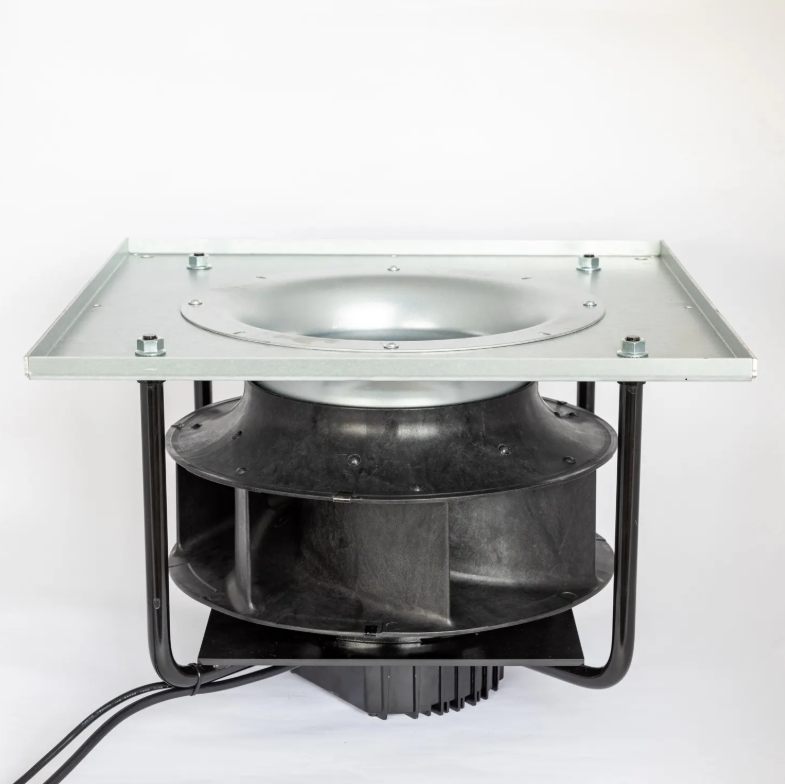
The blade angle tells most of the story
Forward curved and backward curved fans are both centrifugal machines. Air enters the eye and leaves radially. The difference starts at the blade tip. Forward curved blades lean in the direction of rotation. Backward curved blades lean away. That single geometry choice changes pressure, flow, efficiency, noise, and how the wheel handles dust. Forward curved wheels usually have many shallow blades and run at lower speed for a given flow. Backward curved wheels have fewer, deeper blades and can spin faster without losing stability.
How forward curved wheels move a lot of air in a small package
A forward curved impeller, often called a squirrel cage, packs many blades around a small diameter. It can move high airflow at low static pressure. That makes it common in fan coils, small air handlers, and compact ventilation boxes. The blade passages are narrow, so dust and grease can collect. Once the wheel is dirty, balance shifts and vibration rises. Efficiency is modest compared to backward designs, especially at higher pressure. The curve is steep, so small pressure changes can cause large flow changes.
Why backward curved fans win in higher pressure ducted systems
Backward curved blades handle static pressure better. They are self cleaning to a degree because particles tend to leave the blade surface instead of sticking. Fewer blades mean wider passages and less chance of clogging. The efficiency peak is higher and broader, which matters when filters load up or dampers move. These wheels can run at higher tip speeds, so a smaller diameter can do the job of a larger forward curved wheel. The tradeoff is cost and sensitivity to off design flow. At very low pressure, a forward curved wheel may be the cheaper choice.
| Feature | Forward curved | Backward curved |
|---|---|---|
| Blade direction | leans with rotation | leans against rotation |
| Typical blade count | high, 30 to 60 | low, 8 to 16 |
| Pressure capability | low to medium | medium to high |
| Peak efficiency | lower | higher |
| Dust resistance | poor, narrow passages | better, wider passages |
| Noise character | broad, often higher frequency | smoother, lower frequency |
| Common use | fan coils, compact AHUs | ducted AHUs, cleanrooms, OEM |
| Speed range | limited by blade stress | higher tip speed possible |
Noise and vibration behave differently with each wheel type
Noise is not just a number. It has a character. Forward curved wheels often produce a broad, high frequency sound because many blades pass the cutoff. Backward curved wheels tend to have a lower tone and a smoother spectrum. That difference matters in hospitals, offices, and residential ventilation. Vibration also differs. A forward curved wheel with many blades can lose balance quickly when dust builds unevenly. A backward curved wheel is more forgiving, but it can still suffer from resonance if the mounting or duct system is wrong. AMCA Standard 210 and ISO 5801 provide laboratory methods for airflow and pressure testing, so comparisons should use the same setup. A fan that looks good on a free air curve may behave differently at 600 Pa.
A hospital air handling retrofit that exposed the pressure gap
During a 2022 retrofit of a hospital isolation ward in Jiangsu, the existing air handling units used forward curved centrifugal fans. The design needed more filter stages and longer duct runs after infection control upgrades. After the new HEPA filters were installed, static pressure rose. The forward curved wheels moved toward the steep part of their curve and lost airflow. Replacing them with backward curved EC plug fans restored the design flow at the higher pressure. The backward wheels also handled dust better in the pre filter section. One limitation showed up. The backward fans needed a different motor mounting and a larger scroll, so the cabinet had to be modified. The lesson is simple. Forward curved and backward curved choices are not about one being better everywhere. They are about matching the wheel to the system curve.
Matching the wheel to the duty point, not to a catalog headline
Selection starts with the system curve. A forward curved fan can be a good fit for low pressure, high flow, and tight space. A backward curved fan is often the better choice for filters, coils, long ducts, and variable air volume. EC motors add another layer because speed can be controlled to hold flow as filters load. That control only works if the wheel has enough pressure headroom. Buyers should ask for a real fan curve, not a single point. Fanova has worked in EC fan design and manufacturing since 2003, with capabilities across centrifugal, axial, and volute fans. The difference between forward curved and backward curved fans is easy to see on a drawing. The consequences show up in airflow, noise, and maintenance after the system is running.
Table of Contents
- The blade angle tells most of the story
- How forward curved wheels move a lot of air in a small package
- Why backward curved fans win in higher pressure ducted systems
- Noise and vibration behave differently with each wheel type
- A hospital air handling retrofit that exposed the pressure gap
- Matching the wheel to the duty point, not to a catalog headline